Key Takeaways
01 / Intro
A New Operating System for Venture Diligence
In the first quarter of 2026, four companies absorbed roughly two-thirds of all venture capital deployed globally (Crunchbase News, April 2026). The remaining six thousand funded companies competed for what was left. For the venture professionals evaluating those six thousand opportunities, the math of the job has changed. The number of deals to review keeps expanding. The standard for diligence has tightened. The window between first meeting and term sheet has narrowed. And the tools to do the work have advanced faster than any prior generation of investor playbook.
A striking pattern is visible in how the market has responded. Affinity's 2025 Investment Benchmark Report, drawn from a survey of nearly 3,000 venture firms across 68 countries, found that 76 percent of dealmakers now use AI to automate daily tasks, up from 62 percent the year prior. The share of investors using AI to accelerate company research has reached 64 percent. But the share who report using AI to actually make investment decisions has fallen sharply, from 40 percent in 2024 to 13 percent in 2025 (Affinity, 2025).
The pattern is rational. Modern venture diligence is being rebuilt as an AI-augmented process where machines absorb the mechanical work and humans concentrate on the judgments machines cannot make. Funds that adopt this structure are returning faster, sharper investment committee memos with deeper coverage. Funds that resist it are systematically losing speed-and-quality battles to those that do not.
This playbook describes the system that high-performing funds are converging on. Five layers, applied in sequence, anchor a modern due diligence process built for AI-era startups, AI-augmented diligence teams, and the post-2024 regulatory environment for venture advisers. The framework holds equally for institutional VCs, corporate venture capital units, family offices investing directly, and emerging fund managers building diligence systems from first principles.
02 / Context
Why VC Due Diligence Has Changed in 2026
The structural drivers behind the new diligence playbook are concrete and measurable. Five shifts have remade the work.
The first is the scale and concentration of AI investment. The OECD reported in February 2026 that AI firms captured 61 percent of global venture capital in 2025, doubling AI's share from 30 percent in 2022. The Stanford HAI 2025 AI Index Report showed United States private AI investment reaching 109.1 billion dollars in 2024, roughly twelve times China's figure and twenty-four times that of the United Kingdom. Generative AI alone attracted 33.9 billion dollars in 2024, up 18.7 percent year over year and more than 8.5 times the 2022 level (Stanford HAI, 2025). Diligence priorities now follow the capital, and the capital has moved decisively into a single category.
The second shift is the nature of the asset being underwritten. Traditional software companies and AI-native companies look similar on a pitch deck and diverge sharply under stress. AI-native businesses depend on third-party foundation models whose prices can move, training data whose legal status can be contested, evaluation harnesses that determine product reliability, and inference economics that scale non-linearly with usage. A 2024-vintage SaaS diligence template applied to a 2026-vintage AI agent startup misses the categories that determine whether the company survives the next pricing cycle.
The third shift is the source quality of signals. Generative tools have lowered the cost of producing a polished pitch deck to near zero. Investors who previously read deck quality as a proxy for founder rigor must now look past presentation entirely. Diligence has migrated from interpretation of artifacts to direct verification: customer calls, product use, infrastructure invoices, model evaluation results, and code-level review.
The fourth shift is happening inside the diligence team itself. McKinsey & Company described in Five Ways to Improve Due Diligence Using Gen AI how outside-in diligence work that used to require weeks of manual effort can now be compressed by generative AI that synthesizes public and proprietary data, identifies trends, and surfaces outliers. Bain & Company's Global Private Equity Report 2026 reported that AI has taken on a central role in private capital diligence, with leading teams developing scorecard-based protocols to assess generative AI threats and opportunities in every diligence the firm conducts, with the aim of making AI assessment as routine as legal or commercial diligence. PwC benchmarks have documented productivity gains of 35 to 85 percent across competitor analysis, financial review, and document synthesis.
The fifth shift is regulatory. The United States Securities and Exchange Commission's 2024 Division of Examinations Priorities explicitly named registered venture capital adviser diligence practices as a review area, a signal that the supervisory floor for documenting investment decisions has moved upward. Funds whose IC memos cannot be traced back to specific evidentiary sources are operating with a thinner margin of regulatory safety than they were a cycle ago.
The aggregate effect is that diligence in 2026 is no longer a checklist applied to a deal. It is an operating system applied to a fund.
03 / Framework
The Five-Layer Diligence Stack
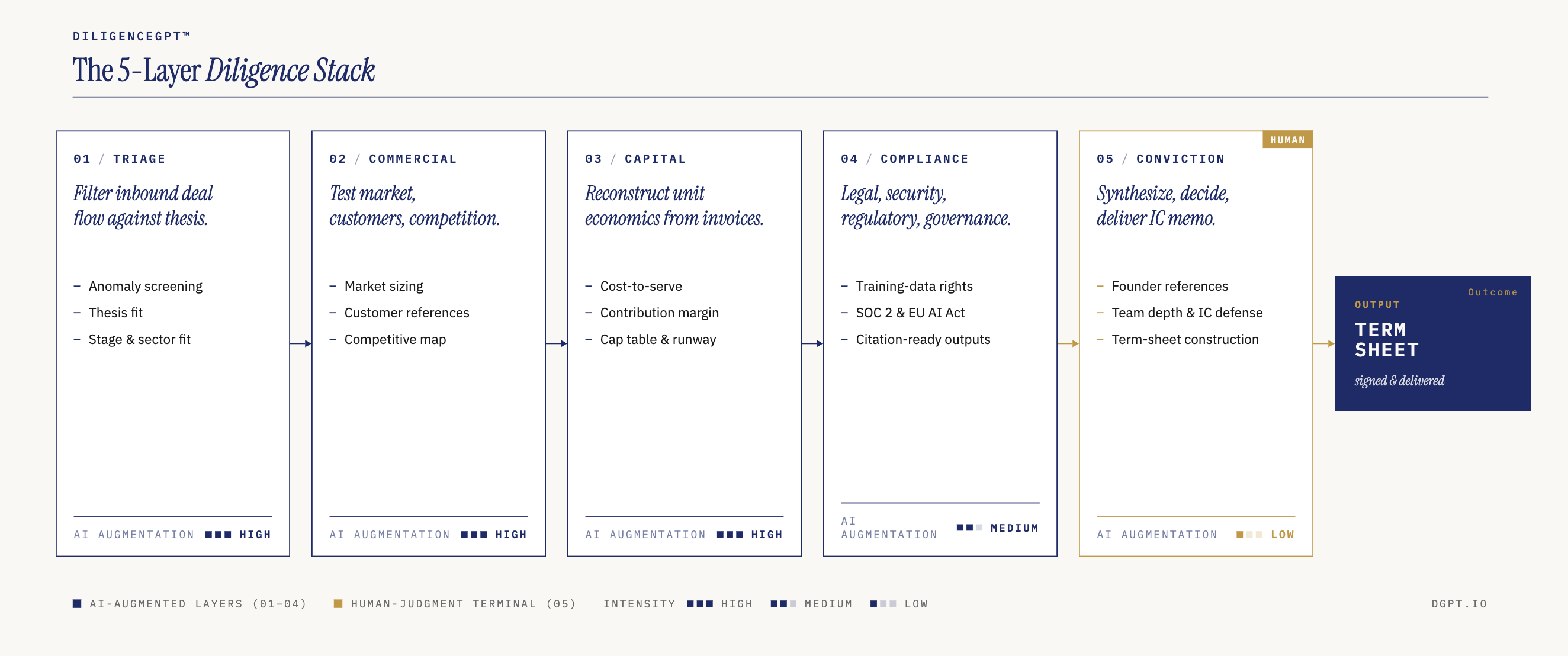
The framework that high-performing funds are converging on can be expressed as five sequential layers. Each layer has its own scope, output, and AI-augmentation profile. Each builds on the layer below. The stack runs from initial screen to investment decision, and the rigor compounds as the deal progresses.
Layer 1Triage
Triage filters inbound deal flow against the fund's thesis, stage focus, sector mandate, geographic footprint, and check size. The objective is to convert a continuous stream of opportunities into a managed pipeline with high signal density.
Harvard Business School professor Paul Gompers and colleagues established the empirical baseline in How Venture Capitalists Make Decisions, a survey of 885 institutional venture capitalists at 681 firms. For every roughly 100 opportunities a fund considers, 25 lead to a management meeting, around 8 are reviewed at a partners meeting, and only 4 reach the due diligence stage. In 2026, AI compresses the cost of the top of that funnel without changing the geometry. Anomaly detection across cap tables, founder backgrounds, market sizing claims, and competitive positioning produces a structured red-flag report within hours of receiving a deck.
The output of Layer 1 is a binary decision: advance the opportunity to Layer 2 or decline it with a documented reason. High-performing funds resolve triage within 48 to 72 hours of first meeting. AI is best used here to widen the funnel without diluting the signal, so that fewer high-quality opportunities are missed and fewer low-quality opportunities consume partner attention.
Layer 2Commercial
Commercial diligence tests the company's market thesis, customer signal, competitive position, and go-to-market mechanics. This layer answers the question of whether the opportunity exists at the size and shape that the company claims.
The work spans market sizing built from top-down, bottom-up, and reasoned-analog perspectives; customer reference calls conducted with a structured protocol of evaluation, implementation, and outcome questions; competitive mapping that explicitly includes foundation model providers and AI-native entrants; and go-to-market diagnostics that test cohort retention, expansion economics, and sales efficiency. AI accelerates this layer by synthesizing expert transcript libraries, customer review patterns, and public competitive signals into an evidence-ranked brief. The judgment about whether the brief supports the company's thesis remains a human task.
For corporate venture investors, commercial diligence has an additional dimension: testing the realistic 12 to 24 month path for the target's technology to pilot inside the corporate's lines of business. The Boston Consulting Group's research on corporate AI investment (BCG AI Radar, 2026) found that nearly three-quarters of CEOs are now their company's primary AI decision maker, twice the share of the prior year. CVC diligence that does not engage that decision authority early is unlikely to convert into operational adoption.
Layer 3Capital
Capital diligence tests the company's unit economics, cost structure, financing history, and runway against the thesis being underwritten. The layer answers whether the business model generates returns that justify the investment.
Modern capital diligence reconstructs cost-to-serve per request or per workflow from cloud provider invoices, model usage parameters, and contract terms. Contribution margin per unit, sensitivity to provider price increases, and margin durability under scale are now first-order diligence outputs rather than back-of-envelope estimates. Cap table review covers ownership, dilution math, vested versus unvested equity, and the implications of secondary transactions for incentive alignment. Burn rate, runway, and milestone-to-next-round modeling test the realism of the company's capital plan.
AI accelerates this layer by parsing invoices, contracts, and financial statements at speed, building cost-to-serve models from heterogeneous inputs, and running scenario analyses across pricing and provider shifts. McKinsey's analysis of generative AI in private equity diligence reported improvements of up to 35 percent in predictive accuracy on financial and commercial questions when AI is integrated into the workflow.
See it run · 20 minutes
See the diligence stack run live on your next deal.
Watch DiligenceGPT™ ingest a data room and produce a structured, citation-linked IC memo across all five layers.
Book a 20-min demoLayer 4Compliance
Compliance diligence covers legal, security, regulatory, and governance domains. In an AI-era deal, this layer has expanded materially.
Legal review now extends to training data provenance and licensing, customer contract terms governing AI outputs, IP ownership of model weights and fine-tunes, and employment terms for AI engineering talent. Security review covers SOC 2 readiness, encryption at rest and in transit, controls against prompt injection and data exfiltration, and incident response capability. Regulatory review is sector-specific: HIPAA for healthcare AI, financial services regulation for fintech AI, and the European Union AI Act for any company with EU customers or users. Governance review tests for documented model evaluation harnesses, audit trails, and a responsible AI policy that addresses bias mitigation and human oversight.
The standard for Layer 4 in 2026 is citation-ready output. Every claim in the IC memo should trace to a specific document, contract clause, evaluation result, or policy. AI compresses this layer significantly by extracting clauses, flagging anomalies, and cross-referencing customer contracts against data handling practices. The supervisory environment, including the SEC's 2024 examination priorities, has made this rigor a practical requirement rather than a discretionary best practice.
Layer 5Conviction
Conviction is the final layer and the one where AI does the least and human judgment does the most. This is where Layers 1 through 4 are synthesized into an investment thesis, where founder and team references are conducted, and where the IC memo is written, defended, and converted into a term sheet decision.
Founder reference calls in 2026 follow structured protocols and cover multiple independent sources. Team depth covers AI and ML talent density, hiring pipeline for critical roles, key-person risk, and the team's specific experience deploying models into production. The IC memo translates the evidence accumulated in Layers 1 through 4 into a clear thesis statement, a stated set of fatal-risk hypotheses that the investor is committing to, and a defined path to the next round.
The Affinity 2025 benchmark data point bears repeating here: only 13 percent of venture investors report using AI to make investment decisions, down from 40 percent the year prior. The reason is structural. Conviction is the layer where qualitative pattern matching, founder rapport, and accountability for outcomes converge. AI inputs are valuable in Layer 5, but the decision itself is, and will remain, a human responsibility.
04 / AI-Native Addendum
How to Conduct Due Diligence on AI-Native Startups
Most of the diligence categories above apply to any venture investment. A specific subset applies only to AI-native businesses, where the underlying economics differ from traditional software. Four sub-categories define this work.
Sub-Layer AModel Risk
AI-native companies depend on models. Diligence must establish which models the company uses, where those models run, who owns the weights, and what the portability plan looks like if the underlying provider changes terms.
The fundamental questions are: Does the company depend on a single external foundation model provider? Are there documented fallback plans for provider changes? Does the company maintain a model evaluation harness with reproducible tests and tracked metrics? How does the company handle model drift over time? A company that cannot answer these questions in a 60-minute technical session has not yet built the operational discipline required for an AI-native business at scale.
Sub-Layer BTraining Data Rights
Training data has become the primary contestable asset in AI diligence. The questions span legal basis, technical traceability, and ongoing rights management.
What is the documented legal basis for the data used in training and fine-tuning? Are customer data clauses consistent with how the company actually uses customer data for model improvement? Can the company honor deletion and opt-out requests in a reasonable timeframe? How much of the training pipeline depends on synthetic data, and what are the implications for model performance and IP claims? Ferguson Analytics estimates that approximately 60 percent of AI projects use synthetic data by 2025, a figure that complicates traditional "proprietary dataset" claims and requires investors to assess provenance more granularly than in prior cycles.
Sub-Layer CInference Economics
Inference cost is the new gross margin. Diligence must reconstruct unit economics that explicitly account for model usage, context length, safety filtering, and provider pricing tiers.
The questions are concrete. What is the company's cost-to-serve per request and per workflow, derived from invoices rather than founder estimates? How does cost-to-serve change with usage volume, and how does that compare with the company's pricing structure? What happens to gross margin under a 20 percent provider price increase, a fivefold increase in usage, or a shift to a different model family? Companies that have not stress-tested their inference economics are exposed to margin compression that traditional SaaS benchmarks will not catch.
Sub-Layer DDefensibility Decay and Agentic Durability
Traditional software defensibility relied on implementation friction, multi-year contracts, and integration complexity. AI-native defensibility relies on proprietary data flywheels, specialized workflows, and distribution lock-in. Ferguson Analytics has documented that first-mover data advantages in AI typically last 12 to 18 months unless the company has built workflow integration or regulatory protection that compounds with time.
The diligence question is whether the company has constructed a moat that survives commoditization of the underlying foundation models. Specific tests include: Does the company own a data asset that an AI-native startup building from scratch in 2026 could not replicate within 18 to 24 months? Does the product execute work autonomously inside customer workflows, or does it surface information for a human to interpret? Are customer integrations deep enough that switching costs are material? An honest answer to these questions usually distinguishes durable AI businesses from wrapper companies.
05 / Workflow
How VCs Are Using AI Inside the Due Diligence Process
The diligence team itself is changing. The most consequential operational shift in the venture industry over the past 18 months has been the migration of AI from a thematic investment category into a core workflow technology inside the diligence function.
The benchmark productivity gains are substantial. PwC has reported 35 to 85 percent reductions in diligence task time across competitor analysis, financial review, and document synthesis. McKinsey has documented that outside-in diligence which formerly required weeks of analyst time can now be conducted in days using generative AI to synthesize public and proprietary data. Bain & Company's 2026 PE report describes scorecard-based AI assessment protocols becoming as routine as legal or commercial diligence.
The structural reallocation behind these gains is the conversion of the analyst role. Pre-AI diligence teams spent roughly 90 percent of analyst time on data gathering and 10 percent on strategic judgment. AI-augmented teams reverse the ratio, redirecting senior time to interpretation, founder engagement, and IC defense. The output is not a smaller diligence team. It is a deeper one.
The Affinity 13 percent data point sets the boundary. AI accelerates research, accelerates document review, accelerates competitive synthesis, and accelerates IC memo drafting. AI does not, and should not, replace the investment decision. Funds that have attempted full automation have encountered three predictable failure modes: encoded biases in training data that map poorly to next-cycle markets, overfitting to historical patterns that did not hold in the AI era, and loss of qualitative texture in founder evaluation that determines outcomes more than any other input.
The best operating model in 2026 is a clear human-in-the-loop separation. AI handles the mechanical synthesis, the document parsing, the cost-to-serve reconstruction, the competitive map, and the first draft of the IC memo. The investor handles the conviction, the founder reference call, the IC defense, and the final decision. Each layer of the diligence stack is faster and better when this separation is observed.
06 / Fund Operations
The Emerging Fund Manager Due Diligence Playbook
Emerging managers, defined as funds in their first through third institutional vehicle, account for 44.7 percent of all venture fund count but only 15.4 percent of capital raised, according to PitchBook 2024 data. Through the first half of 2025, US-based sub-250 million dollar venture firms raised only 1.41 billion dollars across 27 funds (PitchBook via Axios Pro). The fundraising compression is structural and is not expected to ease materially through 2026.
For emerging managers, the operational implication is direct. Building institutional-grade diligence inside a one to three person investment team requires substituting AI for the analyst and associate scaffolding that established firms inherit. The good news is that the substitution works. The 5-Layer Diligence Stack scales down without losing structural integrity. Triage, commercial, capital, compliance, and conviction can all be executed by a small senior team augmented with AI tooling that performs the work an associate would have performed three years ago.
The competitive position this enables is meaningful. Emerging managers who present LPs with an institutional-quality diligence process, codified templates, scorecards, and citation-ready memos signal operational maturity that disproportionately accelerates LP confidence. Founders see the same signal. A first-time GP whose diligence rivals a top-decile fund's process moves up the founder's preferred-investor list quickly.
The structural advantage of starting fresh is that the playbook can be designed for the 2026 environment without legacy process debt. The disadvantage is that the discipline of codifying the process must come from the GP, since the institutional muscle memory is absent. The funds that solve this problem early will compound the advantage across every vintage they raise.
07 / Tooling
Modern VC Due Diligence Tools and Software
The 2026 venture diligence stack spans several categories, each with mature commercial options.
Relationship intelligence and deal pipeline management runs on platforms such as Affinity, 4Degrees, and Standard Metrics, which manage the CRM layer that emerging managers and established funds use to track relationships, deal flow, and portfolio reporting. Market data and private market intelligence is dominated by PitchBook, CB Insights, Crunchbase, and Harmonic, which provide the structured datasets that feed sector mapping, comparable analysis, and competitive landscape work. Expert networks anchored by AlphaSense, Third Bridge, and Tegus aggregate the call transcripts and proprietary expert content that ground commercial diligence in primary sources. Virtual data rooms remain the operational layer for document exchange, with Datasite, Carta, and Intralinks providing the standard infrastructure.
The AI-augmented diligence layer is the newest and most active category. Purpose-built platforms ingest pitch decks, data rooms, and unstructured documents and produce structured, scored, citation-linked outputs aligned with the diligence stack described above. DiligenceGPT™ was built specifically for venture capital and private capital diligence in the AI era, with native handling of the model risk, training data rights, inference economics, and agentic durability categories that no general-purpose tool addresses.
The category survey matters because tooling is commoditizing quickly. The differentiator is not which platform a fund uses but whether the fund has codified a method that the platform executes. Method is durable. Tools are not.
08 / Closing
A System for the Next Era of Venture
Venture diligence in 2026 is no longer a checklist applied to a deal. It is an operating system applied to a fund. The five-layer stack, the AI-augmented workflow, the new category of AI-native startup risk, and the supervisory environment for venture advisers together describe a discipline that has matured considerably from the 2021 cycle.
The funds that win the next vintage will share three characteristics. They will codify their diligence process explicitly, with templates, scorecards, and decision protocols that survive personnel changes. They will integrate AI as an augmentation layer across every stage of the stack, while preserving human judgment as the source of conviction. And they will treat the playbook as a living document, updated against portfolio outcomes, regulatory developments, and the rapid evolution of AI capability that defines this decade of venture.
The framework above is one expression of that discipline. It is offered as a starting point, not a final form. The most valuable refinement will come from each fund's own application, iteration, and post-mortem analysis. Diligence is the part of venture investing where the work of compounding actually compounds.
09 / Frequently Asked Questions